

A Legacy of Service for Honorary Life Trustee James P. Brett
A glimpse into a long history of doing what's right.

The last weeks of severe cold across Chicago have turned ordinary goodbyes into small acts of care: stay warm, text me when you get home, don’t stay out too long. The city moves carefully in weather like this. Neighbors take notice of who is outside, who is waiting, who might need a ride. From behind a glass door on the corner of Pulaski and 79th Street, a bundled bank security guard waves off a parking restriction for just long enough to take a photo of Bogan High School’s 70-year-old facade, once the backdrop of a national conflict about who belongs and who does not.
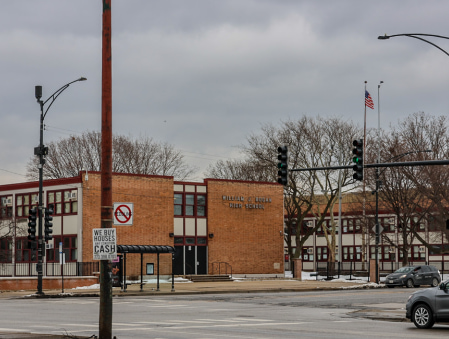
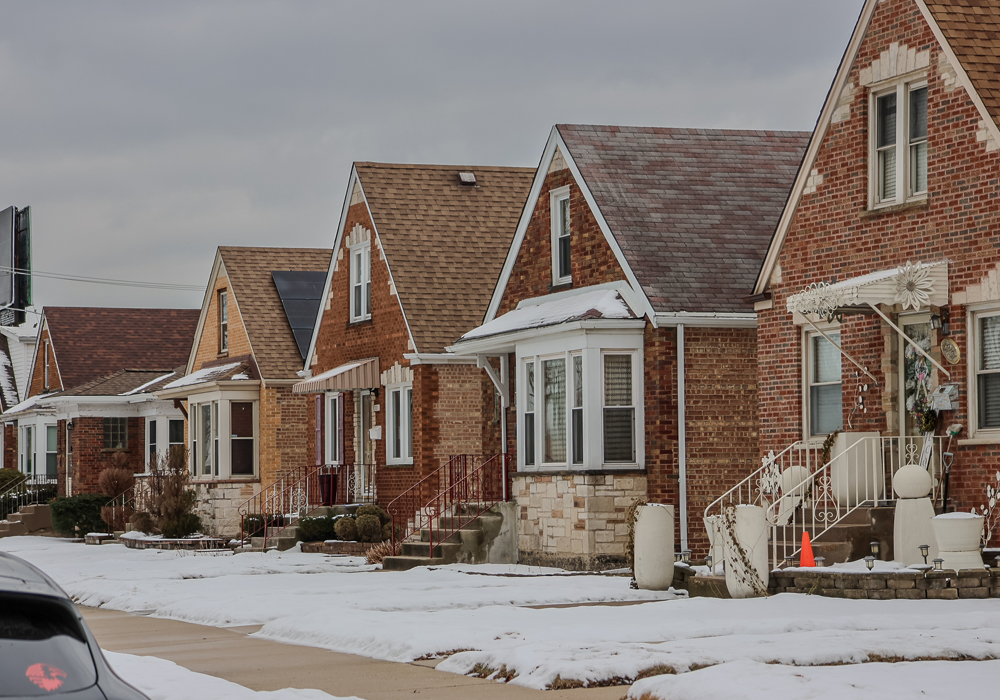
The Bogan Area (known by the uninitiated as Ashburn), just south of Midway Airport, calls little attention to itself among Chicago’s outlying neighborhoods. Neat single-family homes line the dense grid of one-ways alongside the occasional two-flat or three-story walkup— a brick and mortar recounting of America’s last century of evolution.
Built to serve the predominantly white, working-class members of three nearby Catholic parishes, Bogan High School opened its doors in 1959 to a changing city. The neighborhood itself was developing rapidly: William J. Bogan Junior College (now Richard J. Daley College) would offer its first classes the following year; John F. Kennedy was campaigning to become the country’s youngest elected president; Ike Eisenhower’s Chicagoland interstate highways had already seen several years of use and were nearing completion. The people displaced by that construction had begun to resettle elsewhere, some between the 7400 and 8800 blocks of South Pulaski Road.
As families arrived from other parts of the city, pushed farther afield from the urban center by redevelopment along the Near West Side, longtime Bogan area residents sorted themselves and each other into ideological camps with opposing views on who their neighborhood was for and who its institutions should serve.
✶
James P. “Jim” Brett—the elder of the two Jims who contribute to this story, and the second of three generations to carry the name—was born to Jim and Irene Brett and raised a few miles east of Bogan, in the parish area residents referred to as Little Flower, near 79th Street and Ashland Avenue.
Public service and education framed his childhood. His father worked for the city’s water department on Western Avenue. His mother taught business, English, and history at Harper High School near 65th and Damen, a neighborhood institution that would close in 2021, 110 years after its founding.
Jim attended Little Flower’s parish school before enrolling at Quigley Preparatory Seminary in pursuit of ordination. He continued on to Mundelein Seminary, studying for the priesthood into his early twenties.
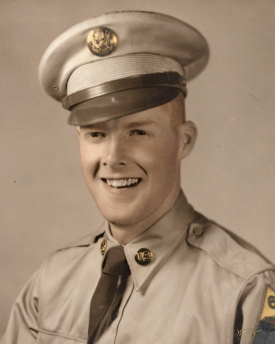
Through fellow seminarians, he met his now-wife Patricia, whom he jokingly credits with redirecting him from that path. He left the seminary, and eventually attended Loyola University. Shortly thereafter, and at the close of the Korean War, Jim joined the Army.
The military trained him on heavy equipment, and much of his service was spent constructing Air Force bases in Japan and the Philippines. “I spent a lot of that two-year time driving a bulldozer or a grader,” he recalls. Tall for his generation and a strong basketball player, he also traveled with Army teams to play in games and tournaments in China and Singapore.
Through an early release program for returning students, he left military service several months ahead of schedule and returned to Loyola, where he completed a degree in philosophy.
Though he chose a different vocation, faith remained a constant force in Jim’s social circle and civic engagement. He was drawn toward work that combined administration with public purpose. A master’s degree in human resources led to a position at Amforge, a Near West Side steel forge along the river at Hoyne Avenue, just a few blocks from Gads Hill Center’s Cullerton Street headquarters.
✶
The beginning of Jim’s human resources career brought the young Brett family to a modest brick bungalow near 84th and Kedzie. They arrived in the Bogan area as conflicts long reported in national headlines were becoming a palpable neighborhood reality.
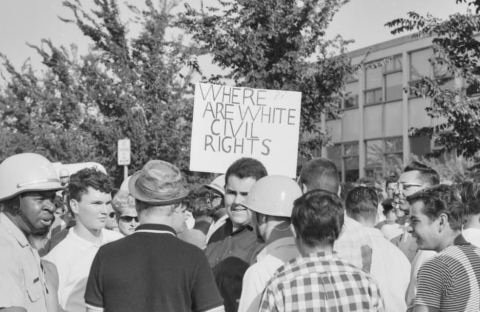
From post on Chicago Greaser/Gangs - The Full Story on Facebook.
Within just a few years of its opening, Bogan High School became a fault line as residential patterns shifted and calls for and against integration reached the far Southwest Side. Community opposition to desegregation coalesced into organized resistance, drawing parish leaders, parents, and local residents into public and private disputes over who belonged in the neighborhood—and whose children belonged in its schools.
At the same time, many of the priests at Mundelein Seminary—friends and former classmates of Jim Brett—were actively involved in the civil rights movement. For them, the issue was not abstract politics but pastoral responsibility. A parish, they believed, existed to serve the people who came to it, regardless of race, class, or background. Brett’s parents and close friends held similar convictions, shaping his own growing interest in the movement.
“That whole period—the late 1950s and early ‘60s—was marked by interracial tension,” Jim recalls. “Problems had been cropping up downtown, in the government, in the community. They were doing their very best to keep Black people out of the Bogan area, Black students out of Bogan High School.”
For Jim, the logic was straightforward: if students lived in the district, they belonged in the school. Asked about his own role, he describes it with characteristic understatement.
“Did a little picketing.”
His son, James A. “Jim” Brett—who recently completed his own term as President of Gads Hill Center’s Board of Directors—offers a different accounting.
“My dad did a lot. He was involved with several community groups.” He adds, “My parents couldn’t go to the March on Washington because they had to take care of me and my siblings, but they gave their wedding rings to friends who were going in case they needed to pawn them for bail money.”
The younger Jim had entered grade school the year his parents moved them to the Bogan area. “Dad wanted to be involved in something bigger than himself,” he recalls. “He started an advocacy group. Their effort to desegregate the high school was…” he pauses in search of a descriptor. “Contentious.”
In response, Jim Sr. returns to his familiar modesty.
“I couldn’t tell you how it built into an actual organization,” he recalls. “All of a sudden I started talking to somebody, asking somebody else, and the next thing you know, there was an interracial advocacy group in Bogan—which was all white at the time.”
✶
The organization the Bretts are referring to was the Bogan Area Community Relations Council, which he helped found in the early ‘60s. Its work quickly moved beyond informal discussion. An October 1965 issue of The Chicago Commission on Human Relations’ Human Relations News of Chicago lists Jim—then, the Council’s Chairman—among the conveners of a 200-person Conference on Human Relations held at Saint Xavier College, now SXU.
In the publication, Jim described the event as an effort to show that “human relations activities are not limited to just one group in one community, but to many groups in many neighboring communities,” and that increasing numbers of residents were beginning to concern themselves with desegregation—even in areas not yet directly affected. The conference approached area residents through education and exposure—a recurring theme in Jim’s public work—in an effort to deepen their understanding of the issues of segregation and integration.
The following year, national newspapers reflected how volatile the situation had become. In August 1966, a Los Angeles Times dispatch by journalist D. J. R. Bruckner, reprinted in Vancouver’s Daily Colonist under the headline Chicago Fears a Blood Bath.
Reporting from Chicago on Rev. Dr. Martin Luther King Jr.’s planned demonstrations in favor of open housing in Southwest neighborhoods, Bruckner described the atmosphere around Bogan:
“Bogan has been an area of intense racial feeling ever since an effort was made in 1964 to register 20 Negroes in the neighborhood high school… Bogan people say they are facing the Negro movement for the second time, and they vow to resist it.”
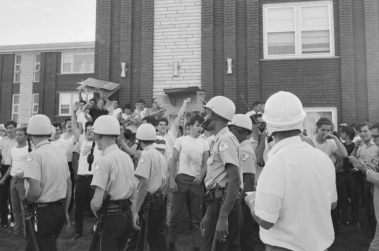
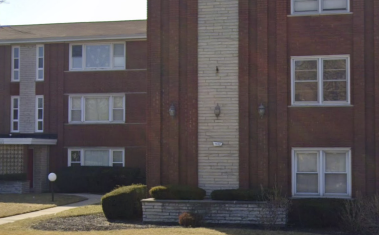
RIGHT: 7932 S Pulaski Rd today. Google Maps.
The piece references nearby Gage Park, where white mobs had attacked civil rights marchers only days earlier, and recalls the 1951 riots in Cicero following the arrival of a Black family.
Mayor Richard Daley and other city officials, the police, and community groups like The Bogan Area Community Relations Council, with its strong ties to Catholic leadership from surrounding parishes, were actively working to prevent what felt like inevitable violence.
On the same page in the Colonist, another headline: Homemade Bomb Rips Office of Rights Group. The Ku Klux Klan had bombed the NAACP’s Milwaukee headquarters earlier that week.
✶
For the Brett family, the conflict did not remain in newspapers or meetings.
The family paid a social price for their position. “My parents didn’t have many friends in the neighborhood beyond the church people,” Jim Jr. recalls. It was a small community; people talked. “I had a friend across the street, a kid I played with, whose parents hated mine.” At home, he says, the message from his parents was unambiguous: opposition to integration was wrong.
Two of Jim Jr.’s earliest memories, he says, are of John F. Kennedy’s assassination in 1963 and of an evening at his family’s home in Bogan.
The Bretts were members of an interfaith group—separate from the community relations council—that included Catholic, Methodist, and Presbyterian clergy. Its members took turns hosting the group’s regular meetings. One evening in the early 1960s, the gathering was held at the Brett house.
He remembers that night in particular because, not long after the meeting ended, a bright light flared through the front windows. A wooden cross had been planted on the Bretts’ lawn and set on fire.
His mother would later insist he attend a private high school rather than Bogan. For Jim Sr., however, the episode did not end his involvement. If anything, it clarified it.
✶
In the years that followed, the elder Jim continued his work at Amforge, where the mediation he had practiced in community meetings became part of his profession.
“A good portion of my work in HR at that time was negotiating contracts with the Steelworkers Union,” he says.
The plant sat along the river on the Near West Side, less than half a mile from a small settlement house on Cullerton Street. Pilsen, like Bogan, was a neighborhood defined by arrival. The workforce at Amforge—largely Italian, Polish, and Serbian immigrants—mirrored the surrounding community, and that community was experiencing the same social sea change Jim saw in Bogan.
It was there, thanks to his boss Charlie Matuzyk, that Jim first encountered Gads Hill Center.
Matuzyk had grown up at Gads Hill Center, living in the residential apartments that then occupied the building’s third floor—space that now serves as our administrative offices. After starting at Amforge as an electrician, he worked his way up to plant manager, a trajectory Jim would later view as an embodiment of the Center’s purpose.
As plant manager and a member of Gads Hill Center’s Board of Directors, Matuzyk frequently sent maintenance crews from the forge to Cullerton Street to help with repairs or prepare the gym and yard for events. He often sent Jim with them to oversee the work.
“I still hear today a phrase I heard years ago,” Jim says, recalling his early days at Amforge. “‘I was here back when,’ ‘…when the Polish were here,’ or ‘I was here back when the Irish were here.’”
The refrain is evidence of the Near West Side’s continual evolution over the last 150 years. Its industrial corridors and comparatively affordable housing have made it a serviceable arrival point for immigrant families, whose income often could not rely on their ability to speak English. It was and remains a community where incoming families get an opportunity to find their footing, beginning the multi-generational process of assimilation into a new city.
“As a port of entry, Pilsen was the place you could find your way into the States and into Chicago,” Jim says. “A place where you could work at learning and speaking English.”
The nationalities changed over time, but the pattern did not. Families arrived, established themselves, and gradually moved elsewhere, making room for the next group to begin again.
Jim is careful not to romanticize the period. “There was always tension in the neighborhood,” he says.
✶
In the years after World War II and the Korean War, industrial decline and large infrastructure projects displaced residents from other parts of Chicago. By the mid-century, Mexican families began settling in Pilsen in greater numbers.
Contemporary accounts describe harsh discrimination against the new arrivals as white residents reacted to the influx of Hispanic families. Violence became a regular concern for the community.
Mexican and Latinoamerican gangs formed in response to racially motivated attacks from existing Italian and Polish gangs. The area’s homicide rate would increase throughout the period, exceeding the citywide average before its eventual peak in the late 1970s.
“In the very early years in my time here,” Jim says, gesturing south toward the elevated Pink Line rail that canopies the entrance to Gads Hill Center’s parking lot, “a couple of people were killed in that alley there.”
For a time, police maintained a near-constant presence on the block, sometimes even inside the building itself. Their patrols reassured families, but safety at Gads Hill Center came to depend less on enforcement than on community involvement and reputation.
The Bretts recall Pilsen-native staff and board members meeting with local gang leaders to reduce conflict around the Center. Over time, residents came to see the grounds as neutral territory.
“We worked our way into being a safe spot,” Jim Sr. says. “We worked our way into getting the Polish and the Italians sitting down and actually talking to each other.”
The effect was visible in small ways. The Gads Hill Center Jim would visit with Charlie Matusyk’s Amforge work crews was a haven of camaraderie, community growth, education, and comfort. Children ran freely in the yard and gym; parents breathed easier.
“Not only was it a safe place for kids,” Jim says, “it was a safe place for adults. When they were here, they weren’t looking over their shoulder. They knew that inside our fences was safe ground.”
“All of these different people are here learning to speak English, to work as a human community, so that they could find work within companies and unions that were totally different from them—from language to life experiences,” he says. “They were together. And they were growing.”
Later, the man who introduced Jim to Gads Hill Center, Charlie Matusyk, gave him a life-changing directive.
“Before he retired, Charlie told me, ‘You will be on the board.’ I said, ‘Yes, sir.’”
✶
Jim joined the Gads Hill Center Board of Directors in 1969 and would serve two nonconsecutive terms as its president in the following decade. Asked to name accomplishments from his tenure, he initially deflects. “No, I can’t think of anything.”
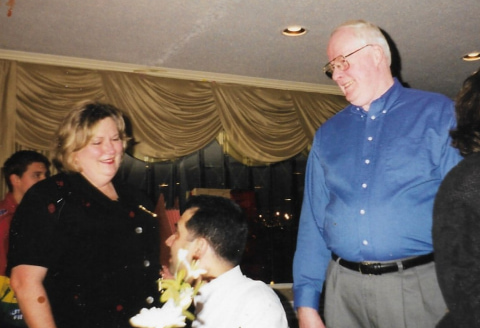
His son steps in to jog his memory. “Dad had a hand in bringing in some good people.”
Jim Brett Senior played a key role in executive searches that brought Barbara Castellan and, later, Maricela Garcia to the organization—leaders who guided Gads Hill Center through decades of modernization and expansion. During their tenures, the organization grew from its Pilsen home to multiple locations across Chicago’s South and West Sides, significantly expanding its reach, its services, and its impact.
For Jim, however, the Center’s value to its community has never rested solely in leadership.
“I always talk to people about Edwin,” he says, referring to longtime staff member Edwin González. “He’s the only one around here who’s been around longer than I have. He was a little kid when Charlie first brought me here. He grew up here the same way Charlie did, living on the third floor.”
He pauses, then adds with a kind of reverence,
“I’ll never know the true extent of his work, but I have a strong sense Edwin was in the street with those kids sometimes, if necessary. Maybe going to their houses when they needed it. I don’t know what makes me say that—it’s just my sense of his contribution. It was never just a job to him.”
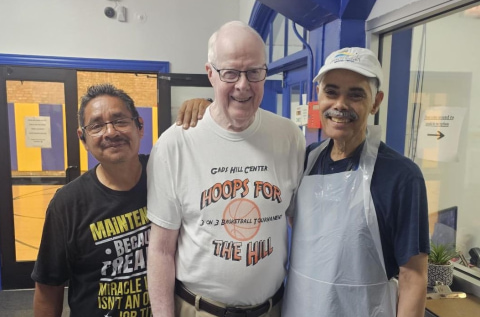
Jim Jr. sees a familiar pattern in his father’s camaraderie with Edwin and Juan Fernandez, GHC's facilities manager.
“It doesn’t surprise me,” he says. “When I was a kid, my dad would sometimes take me to Amforge on Saturday mornings. Before we left, he’d walk the whole plant floor, stopping to talk to the guys working the weekend shift. It was loud and dirty and intimidating to me, but he made time for everyone. That’s just who he was, and who he is. It explains why he recognizes the contributions of someone like Edwin or Juan—not just senior leadership.”
✶
For Jim, leadership was never abstract. It was relational—visible in small conversations, steady presence, and the assumption that everyone in the building, from executives to kitchen staff, carried the institution’s mission.
That disposition proved essential as Pilsen continued to shift from largely Polish, Italian, and Serbian families to a predominantly Latino community. Gads Hill Center faced new and sometimes competing ideas about its role.
Both Bretts remember those years as complicated but consequential.
“It was associated with the change in the community,” Jim Jr. says. “Different needs. Different expectations about how to serve them.”
Jim Sr. found himself in a familiar role: helping people work through their differences so the group could better serve the changing neighborhood around it.
Asked whether his years spent negotiating labor contracts and mediating disputes contributed to resolving the internal tension, Jim resists claiming credit.
“I’d like to be able to say yes,” he says. “But I really have no idea.”
From his point of view, Jim saw continuity rather than transformation.
“I don’t see any great change in Gads Hill Center’s mission from before, during, or after my time,” he says. “Gads Hill is kids. You gather a bunch of little kids, and you watch them become bigger kids—and then you see them going off to college or trade school. That was the vision years ago. I think it’s exactly the same.”
✶
Even before the recent cold snap, the blocks around the Pink Line’s Damen Avenue stop have been uncommonly empty this winter. The houses of Pilsen stand watchful, their windows and lawns displaying bold-lettered message FUERA LA MIGRA – ICE OUT!
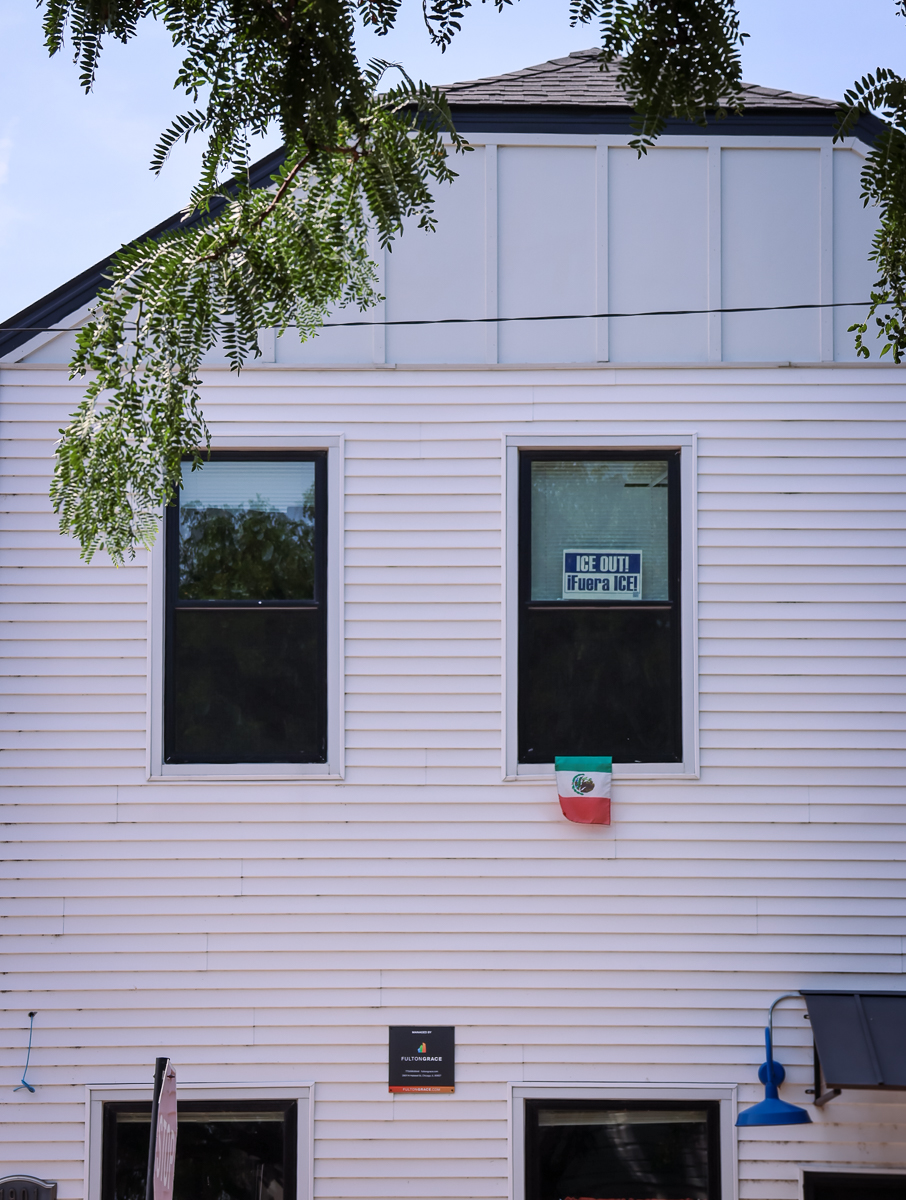
A few yards up Cullerton Street, Gads Hill Center receives squeaky-booted children who’ve just finished their school day. They unbutton their coats and stuff their gloves into their pockets as they file past the Brett Family gymnasium—dedicated over a decade ago in gratitude to the contributions and service of a man named Jim and his family.
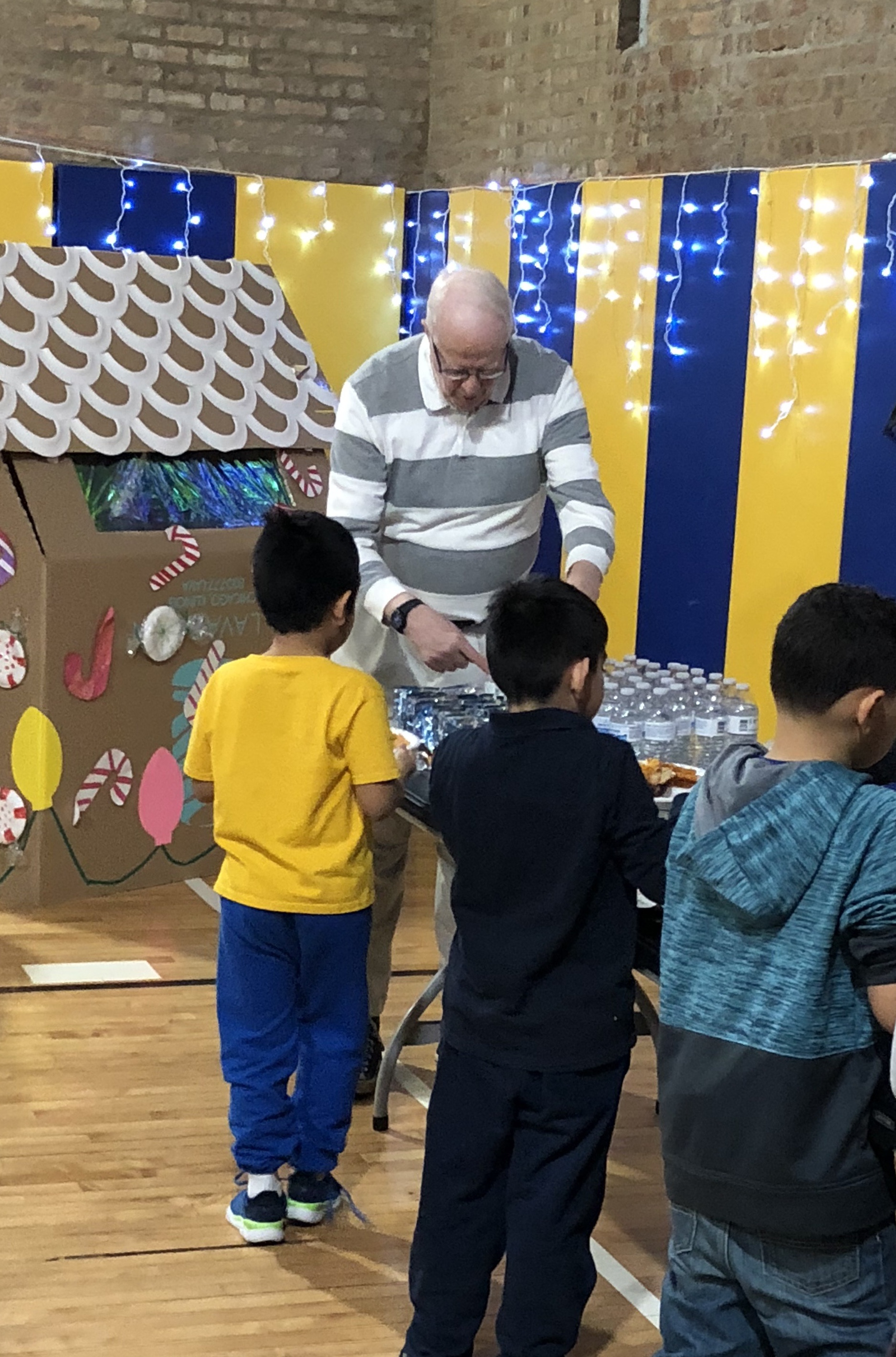
Jim Brett has dedicated his life to the service of those around him. Gads Hill Center, thanks to that service, continues to be a safe and steady place for families navigating immigration systems, economic precarity, language barriers, and instability intensified by public policy and political rhetoric. This institution is only part of his legacy.
For more than half a century, Jim has responded to his neighbors’ needs with intention, humility, and presence in meetings, on picket lines, in hiring committees, in quiet conversations in hallways and kitchens.
This year, Gads Hill Center named Jim Brett an Honorary Life Trustee of its Board of Directors. The recognition formalizes something this community has long understood: that his relationship to the organization is no longer measured in board terms or service years, but in stewardship.
Asked about the future of Gads Hill Center, Jim offers a characteristic deflection.
“It takes people smarter than me and younger than me to figure out how to do it now,” he says, smiling.
“We’ve been around about 125 years. And I wouldn’t be anything but happy if I were hanging around here 125 years from now, telling you the same thing.”