

Inside Chicago's People's Hearing
Accountability and Action: Second People's Hearing Comes to Chicago
Contributed by Rutaiba Siddiqui
“Nothing human is alien, but today, this government of ours has sought to dehumanize us, and we know what happens when any community is dehumanized,” said Marty Castro, former Chair for the U.S. Commission on Civil Rights. “The road leads to a very dark place, and it is up to each and every one of us…that that darkness stops, that darkness recedes, and the light returns.”
The Chicago-based attorney was appointed by Former President Barack Obama to the U.S. Commission on Civil Rights. This appointment made Castro the first Latino to serve as the Commission’s Chairperson.
On May 20th, he presided over The People’s Hearing alongside Rochelle Garza. Garza is the Chair of the U.S. Commission on Civil Rights, and was the first Latina nominated for Texas Attorney General by a major party.
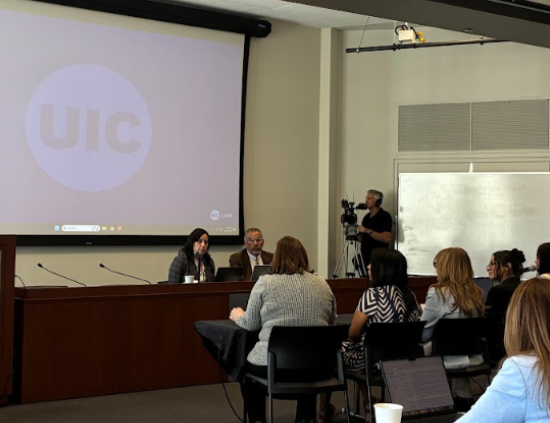
The first hearing, held in Minnesota, functioned as a forum, where community members, advocates, and public leaders came together to share testimony and build a public record of enforcement abuses and community impact. The second hearing was held in Chicago at The University of Chicago Law School.
Here, the hearing served as a public civil rights forum designed to gather factual testimony and build a public record regarding enforcement actions, including use of force, deaths involving federal officers, deaths in custody, warrantless stops, and impacts on community safety and civic participation.
“400,000 people have been detained in this country by immigration persons, since the Trump administration started. 145,000, U.S. citizen children do not have one of their parents. 22,000 of those kids don't have either of their parents because of those enforcement efforts,” Garza said.
Convened by Hispanic Federation, the Latino Victory Foundation, and The Miranda Family, Latino Policy Forum, and Latinos Progresando, the symposium was host to a variety of attendees. Of these attendees was Gads Hill Center, a long-standing pillar of the Pilsen community.
Originally named “Gads Hill Social Settlement,” the settlement house was dedicated to the integration of immigrants into the fabric of the community. With offerings of safety and resources for their children's enrichment, Gads Hill has been prioritizing immigrant success since 1898.
Today, Gads Hill Center has grown from one site in Pilsen to four throughout the Chicagoland area. Gads Hill Center continues to serve its community, which was home to disruptions and violence at the hands of Operation Midway Blitz.
“This is the third time in our nation's history. that the federal government has rounded us up, including United States citizens, and sent us to countries that we were not born, and those that were are sent back. So this is not new to us,” Castro said. “But it is up to us to ensure that this does not happen again. And the only way to do that is to show everyone, to document everything, because this is about history. We must document the history, because if we don't, we will be doomed to repeat it. This is also about accountability.”
Beginning the panel was Linda Xóchitl Tortolero, President and CEO of the Latino Policy Forum and a commissioner on the Illinois Accountability Commission.
“What happened in Chicago was not typical immigration enforcement,” Tortolero said. “Federal agents operated in ways, that created danger, intimidation, and chaos. Residents reported agents bringing windows, cars, human force, open chemical agents, detaining people, and kidnapping people, and creating situations where people did not know who was acting under what authority, or what rights they had at that moment.”
Tortolero states that children and young people may feel that belonging is conditional. She discusses how it is challenging for children to feel a sense of belonging when there is no safety in their homes and communities.
“Documenting testimony, gathering evidence, as we are doing today, is as much as about what we want to do for our present individual situation in our country, but it's also about the whole of the future” Tortolero said. “Together, we must fight for the end and that future generations never let this happen.”
“Attending the immigration People's Hearing strengthened Gads Hill Center's civic engagement efforts by increasing our understanding of community needs, enabling us to better advocate for immigrant families and adapt our support as challenges evolve,” says Gads Hill Center Director of Information Technology Oscar De La Torre, who attended the hearing.
At Gads Hill Center, we aim to champion a sense of belonging and identity that is deeply intertwined with the world around these students. When the very fabric of this identity is compromised, it becomes difficult to instill values of valiance. Thus, fighting back against these abuses of power is integral for these children. Doing so must begin with accountability. Doing so must begin with us.